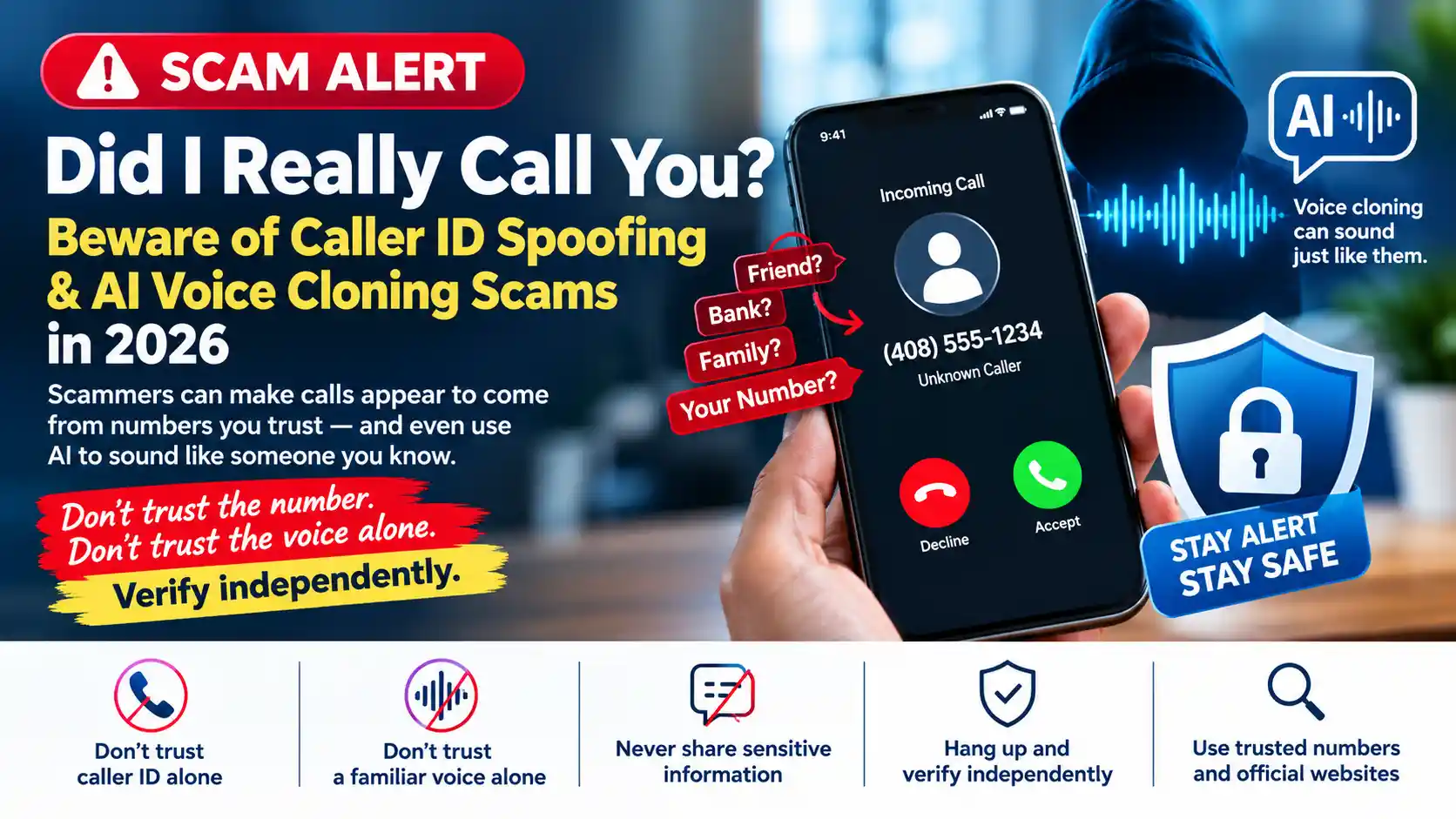
Did I Really Call You? Beware of Caller ID Spoofing and AI Voice Cloning Scams in 2026
Have you ever received a call from a familiar number—only to discover later that the person calling may not have been who they claimed to be?
Or perhaps someone tells you, “I got a call from your number,” even though you never called them.
In 2026, scams involving caller ID spoofing, AI voice cloning, and impersonation are becoming increasingly convincing. A scammer may make a call appear to come from a number you recognize—or even from your own phone number—and may use AI-generated audio to sound like someone you know.
The good news is that there is a simple rule that can protect you in many situations:
Don’t trust the number. Don’t trust the voice alone. Verify independently.
What Is Caller ID Spoofing?
Caller ID spoofing occurs when a caller manipulates the information displayed on your phone so the incoming call appears to come from a different number.
The displayed number could appear to belong to:
- A family member
- A friend
- Your bank
- A government agency
- A business
- A real estate professional
- A title or escrow company
- A mortgage company
- Your own phone number
Did Someone Really Call From Your Number?
Not necessarily.
If someone tells you, “I received a call from your number,” that does not automatically mean your phone was hacked or your SIM card was cloned.
Scammers can spoof caller ID so that the recipient sees a number that belongs to someone else.
This means:
- Your phone may never have made the call.
- Your SIM card may not have been compromised.
- Your phone account may not have been hacked.
- The scammer may simply have made the caller ID appear to be your number.
If this happens repeatedly, it may be reasonable to review your phone account security and contact your carrier if you suspect an actual account or SIM-related issue.
What Is AI Voice Cloning?
Artificial intelligence can now generate remarkably convincing copies of a person’s voice.
A scammer may use a recording of someone’s voice to create audio that sounds similar to that person.
For example, you might receive a call that sounds like:
- A child saying they need help
- A spouse saying they are in trouble
- A relative asking for money
- A business associate requesting an urgent payment
- Someone claiming to be from a financial institution
The voice may sound convincing—but a familiar voice is no longer sufficient proof of identity.
The Most Important Rule: Hang Up and Verify
If a call involves money, personal information, passwords, account access, or an urgent request, don’t rely on the incoming call alone to establish who you are speaking with.
STOP → HANG UP → VERIFY
- STOP: Don’t immediately act on the request.
- HANG UP: End the suspicious or unexpected call.
- VERIFY: Contact the person or organization independently.
How Should You Verify?
Use:
- A phone number you already have saved for the person.
- A trusted number from a previous legitimate statement or communication.
- The organization’s official website.
- An official app or account you normally use.
- Another trusted method of communication.
Important: Do not simply call back the number that appeared on your caller ID.
Also, don’t automatically use a callback number provided by the caller. Instead, find the contact information independently.
7 Simple Rules to Protect Yourself From Voice and Caller ID Scams
1. Don’t Trust Caller ID Alone
Caller ID can be manipulated.
Even if the number looks familiar, local, or official, it does not prove who is calling.
The number on your screen is not identity verification.
2. Don’t Trust a Familiar Voice Alone
A familiar voice can be convincing, but AI-generated voices can imitate people.
If someone asks you to:
- Send money
- Share sensitive information
- Provide a verification code
- Change account information
- Make an urgent payment
Verify their identity through another method.
3. Never Give One-Time Verification Codes to Unexpected Callers
Be extremely cautious if an unexpected caller asks for:
- One-time passwords
- Verification codes
- Passwords
- Banking information
- Credit card information
- Social Security numbers
- Account login information
Never provide sensitive security information simply because someone called you unexpectedly.
4. Be Suspicious of Urgency
Scammers often create pressure so you don’t have time to think.
Watch for statements such as:
- “You have to do this right now.”
- “Don’t tell anyone.”
- “Your account will be closed.”
- “You will lose the money.”
- “You have only a few minutes.”
- “Stay on the phone with me.”
- “Don’t call anyone else.”
Urgency is a reason to verify—not a reason to act faster.
5. Verify Money Requests Through a Second Channel
If someone calls asking for money, don’t rely on the phone call alone.
Instead:
- Hang up.
- Contact the person using a known phone number.
- Send a separate message through a previously established communication channel.
- Contact the organization through its official website or app.
- Confirm the request independently.
6. Be Careful With Links and Unexpected Requests
Unexpected callers may try to convince you to:
- Click a link.
- Download software.
- Install an application.
- Share your screen.
- Log into an account while they remain on the phone.
- Provide remote access to your computer or device.
Don’t follow instructions from an unexpected caller until you have independently verified who they are.
7. When in Doubt, Take a Step Back
You don’t have to make an immediate decision just because someone is calling you.
A simple response is:
“I’ll verify this independently and get back to you.”
Then end the call and verify the request using a trusted source.
Special Warning for Real Estate and Mortgage Transactions
Real estate and mortgage transactions can involve significant amounts of money, making them attractive targets for scammers.
Be particularly careful with requests involving:
- Wire transfers
- Closing funds
- Down payments
- Escrow instructions
- Changes to wiring instructions
- Bank account changes
- Last-minute payment requests
- Sensitive financial information
Never Rely Solely on an Email or Phone Call to Verify Wiring Instructions
Before sending a large payment:
- Independently verify the instructions.
- Use previously known contact information whenever possible.
- Contact the appropriate title, escrow, lender, or other authorized party through a trusted channel.
- Be especially cautious about last-minute changes.
- Confirm any unusual request through a separate communication channel.
When a large amount of money is involved, taking a few extra minutes to verify can be extremely important.
What If Someone Says, “You Called Me”?
If someone tells you that they received a call from your number but you didn’t make the call, don’t immediately assume your phone has been hacked.
Caller ID spoofing could be responsible.
You can:
- Check your recent outgoing call history.
- Check your carrier account for unusual activity.
- Review your account security.
- Contact your mobile carrier if you suspect unauthorized activity.
- Change important passwords if you have reason to believe an account was compromised.
- Enable multi-factor authentication where available.
Most importantly, don’t panic.
Seeing your number appear on someone else’s caller ID does not, by itself, prove that your phone or account was compromised.
A Simple Scam-Protection Checklist
Before acting on an unexpected call, ask yourself:
- ❓ Do I know who is actually calling?
- ❓ Am I relying only on caller ID?
- ❓ Am I relying only on the person’s voice?
- ❓ Are they asking for money?
- ❓ Are they asking for sensitive information?
- ❓ Are they creating urgency or pressure?
- ❓ Can I independently verify the request?
Remember: STOP → HANG UP → VERIFY
If something doesn’t feel right, slow down and verify the information independently.
What Should You Do If You Suspect a Scam?
If you believe you may have been targeted:
- Don’t send money until the request is independently verified.
- Don’t provide passwords or verification codes.
- Don’t click suspicious links.
- Don’t install software because an unexpected caller tells you to.
- Contact your bank or financial institution directly if financial information may be involved.
- Contact the affected company using an official phone number or website.
- Consider reporting suspected fraud to the appropriate authorities.
- Monitor your financial and online accounts for unusual activity.
The Bottom Line
Technology has made scams more sophisticated, but the best defense is often simple:
- Don’t trust the number.
- Don’t trust the voice alone.
- Don’t let urgency make the decision for you.
- Hang up and independently verify.
If a call involves money, personal information, account access, or an urgent request, take a moment to verify the person or organization using a trusted phone number or an official source that you find independently.
That extra step could help prevent a costly mistake.
Disclaimer
Educational and Informational Purposes Only: The information provided in this article is intended solely for general educational and informational purposes. It is not intended to provide legal, financial, cybersecurity, identity-theft, telecommunications, or other professional advice, and it should not be relied upon as a substitute for advice from a qualified professional.
Information about caller ID spoofing, AI voice cloning, scams, fraud prevention, and security practices can change over time. While reasonable efforts may be made to provide useful information, no representation or warranty is made regarding the completeness, accuracy, reliability, or current applicability of the information.
If you believe you have been the victim of fraud, identity theft, unauthorized account activity, or another scam, contact the appropriate financial institution, service provider, government agency, law-enforcement agency, or qualified professional for assistance.
Author is not responsible for any actions taken or not taken based on the information contained in this article.